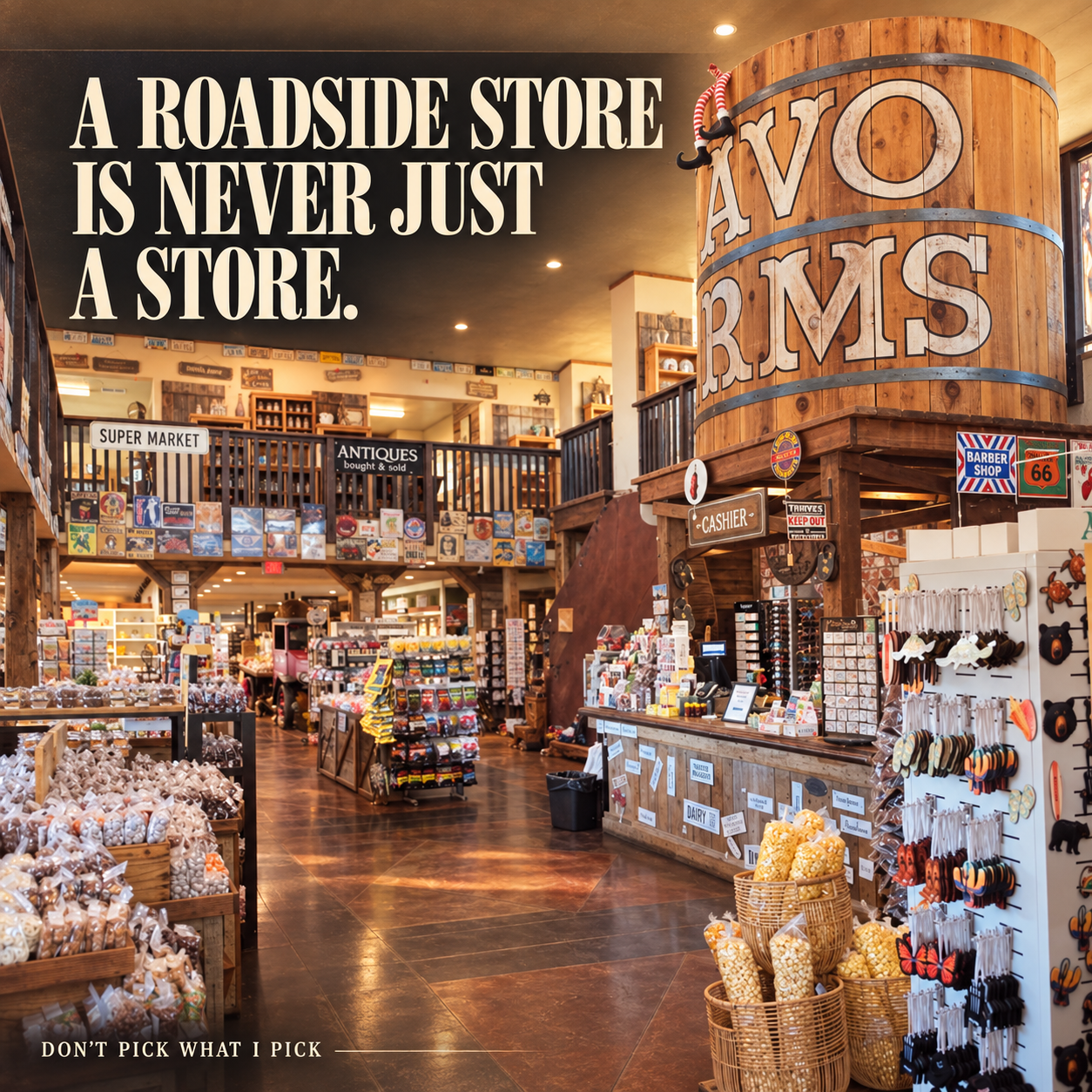
Yesterday, somewhere between where I had been and where I was supposed to go, I stopped at Casa de Fruta.
I stop at roadside stores.
I do not always need anything. I am rarely conducting price comparisons. There is no larger consumer strategy.
I simply see a large sign beside the highway promising fruit, antiques, candy or an unexplained local specialty, and some part of my brain decides there may be information inside that cannot be obtained anywhere else.
Or they might have that hot sauce in a cowboy hat my daughter loves so much.
Usually, the information is that they sell fudge.
Casa de Fruta is not merely a roadside store. It is what would happen if a roadside store gained access to municipal planning authority.
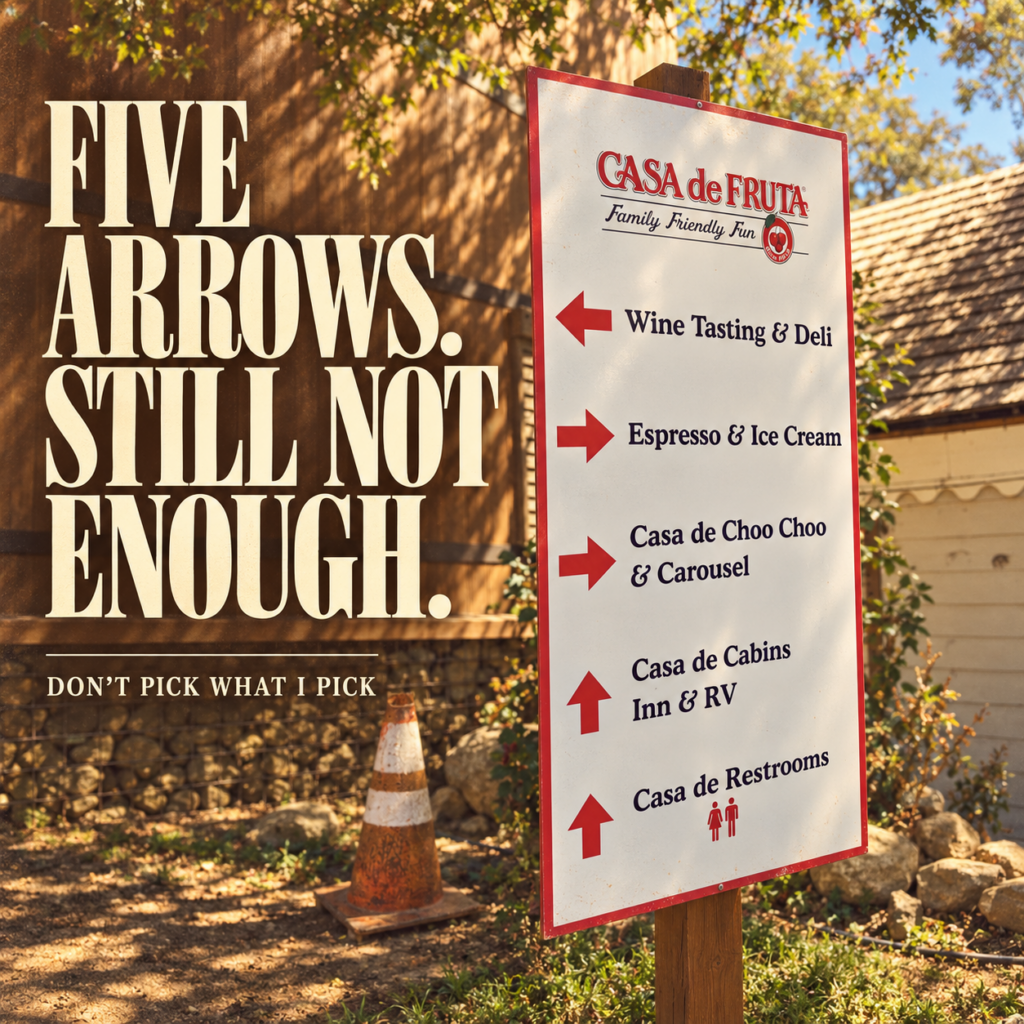
There is a market. There is a restaurant. There is wine tasting. There is espresso. There is ice cream. There is a carousel. There is a train called the Casa de Choo Choo. There are cabins, an RV park and restrooms important enough to receive their own Spanish branding.
The directional sign contains five arrows and still does not fully explain the property.
This is not a business.
This is a small government organized around dried fruit.
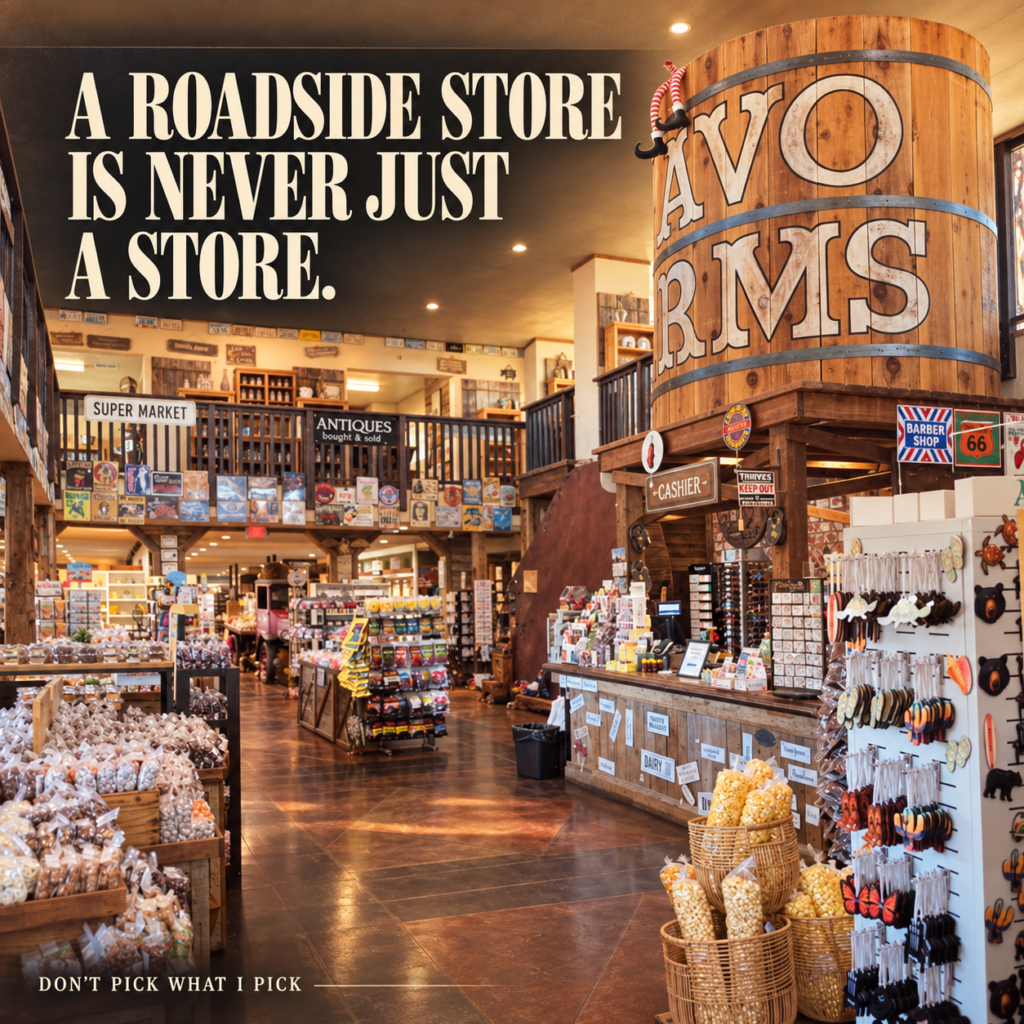
Inside the market, every available surface had been assigned merchandise or historical responsibility.
There were bags of candy, baskets of popcorn, antiques, signs, souvenirs and enough decorative metal to provide several restaurants with fake history.
A giant wooden barrel occupied the cashier area. Somewhere in the building, a prospector operated a shooting game.
Or he had operated one.
The prospector was out of order.
There were handwritten signs confirming this from multiple angles, because one warning was apparently insufficient for a public determined to shoot at an animatronic miner.
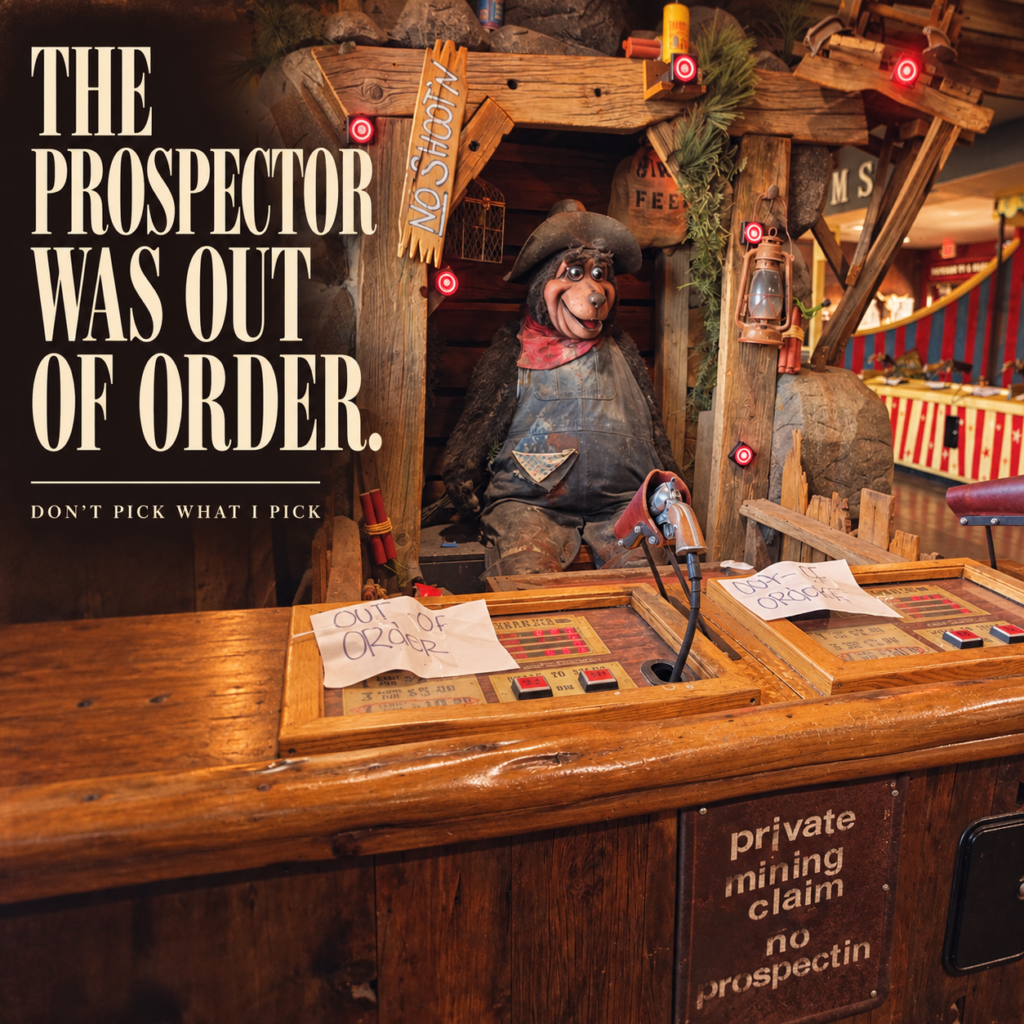
He remained seated inside his private mining claim, smiling through complete professional failure.
I respected that.
There are people who stop functioning and immediately look guilty.
The prospector looked like management had failed to provide adequate support.
Outside, the arrows continued.
Wine and sandwiches to the left.
Coffee, ice cream, a train and a carousel to the right.
Cabins and bathrooms straight ahead.
Five arrows.
Still not enough.
Later, I stopped at a separate farm place.
This distinction matters because Casa de Fruta should not receive credit for every antique tractor in California.
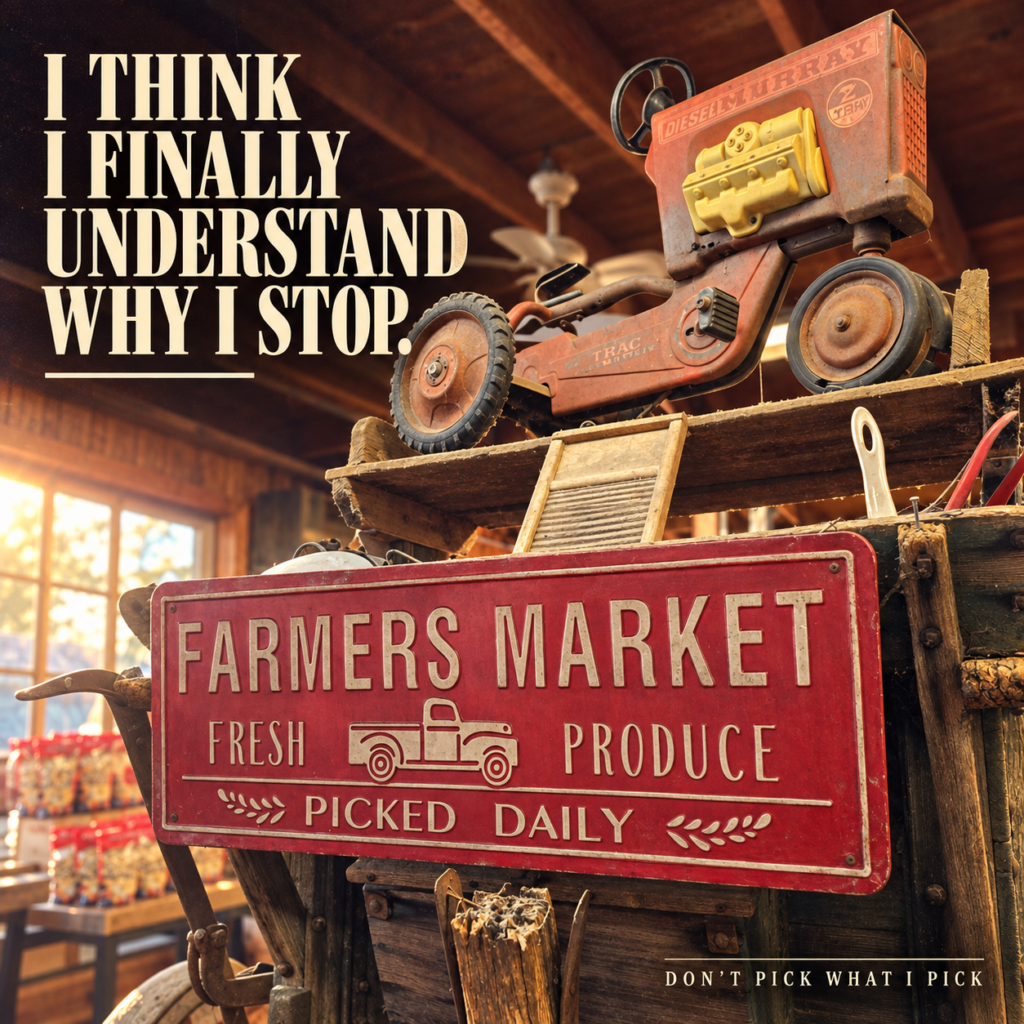
The farm place had old equipment, wooden displays and a Farmers Market sign promising fresh produce picked daily beneath a tractor that had not picked anything in several decades.
It looked less like a store had been decorated and more like an entire barn had been persuaded to participate in retail.
That was when I finally understood why I keep stopping at places like this.
Casa de Fruta started the thought.
The farm place finished it.
Together, they reminded me of my grandparents’ store.
Not because their store contained a train, a wine-tasting room or a failed prospector.
Their store barely contained customers.
But it had the same operating philosophy:
We have accumulated some things. Perhaps you would like to come inside and look at them.
When I was a kid, my parents would ship me off to stay with my grandparents in a tiny town.
Not literally shipped.
There was no box, tracking number or arrangement with the United States Postal Service.
But the overall energy was the same.
My parents handed me over, watched me disappear toward a town with roughly sixty permanent residents and briefly reclaimed a portion of their summer.
My grandparents owned a store there: Gramps and Granny’s Gifts and Antiques.
It was attached to the back of their house.
I was tasked with watching the store while Gramps made more stuff and Granny canned anything that moved.
Hardly anyone came in.
It was less a functioning retail operation than a building where my grandparents waited to see whether commerce might eventually occur.
Every now and then, the door would open and everybody would briefly remember what the store was for.
With roughly sixty residents, the potential customer base was limited before you accounted for the people who did not need anything, did not have any money or had already visited the store once that month.
Next door, go-karts zipped around a track until nearly eleven at night.
These go-karts did not have mufflers.
The same people who could not be persuaded to enter my grandparents’ store suddenly had somewhere loud to be.
But the town came alive for the Fourth of July.
Eventually, everyone grabbed lawn chairs and headed toward the beach for the fireworks.
By everyone, I mean approximately sixty people.
The entire town showed up. There may have been more people sitting on that beach than had entered the store during the previous fiscal quarter.
My grandfather and I carried our chairs onto the beach and found a spot. He opened a Schlitz, because this was a time when grandfathers drank beer with names that sounded like minor workplace injuries.
I looked toward the sky.
It was completely covered in clouds.
Not scattered clouds. Not a few harmless clouds drifting near the horizon.
This was a solid ceiling of weather sitting directly between us and every firework the town had purchased.
I looked at my grandfather and asked the obvious question.
“Grandpa, how are we going to see the fireworks with all the clouds?”
He took a sip of his Schlitz and said:
“Don’t worry about it, kid.”
This was not an explanation.
It was grandfather policy.
Grandfathers did not provide supporting documentation. They issued confident statements while holding domestic beer, and children were expected to accept them as legally binding.
A few minutes later, the fireworks began.
The first rocket launched from somewhere beyond the beach.
We heard it climb.
Then it disappeared into the clouds.
There was a soft explosion, followed by a faint glow from somewhere inside the enormous gray ceiling.
That was the firework.
We did not see it burst.
We saw evidence suggesting that a firework had recently occurred.
The entire town went:
“Ooooooh.”
Another rocket went up.
Another muffled boom.
Another cloud briefly changed color.
“Aaaaaah.”
For the next twenty minutes, sixty people sat in lawn chairs and applauded increasingly expensive illuminated weather.
Nobody complained. Nobody suggested postponing the show. Nobody asked whether the fireworks could be aimed slightly lower.
The town had purchased fireworks.
The calendar said it was time to launch them.
Therefore, the fireworks were going into the clouds.
People reacted as though the sky were producing miracles instead of vague electrical disturbances.
Red glow.
“Ooooooh.”
Green glow.
“Aaaaaah.”
Slightly brighter white area inside the cloud.
“THAT WAS A GOOD ONE.”
It was the lowest-resolution fireworks display ever produced.
The entire show looked like someone had placed a blanket over a television and then turned on the Fourth of July.
And my grandfather had been right.
We did not need to worry about it.
The fireworks were technically there.
The town was technically impressed.
He had a Schlitz.
The store would open again tomorrow, and hardly anybody would come in.
Eventually, my parents would reclaim their shipment.
Everything important had been accomplished.
That may have been the first time I understood that confidence does not require evidence.
Sometimes all you need is a lawn chair, a beer and the willingness to assure a child that the invisible explosions are going exactly according to plan.
Which, now that I think about it, is also a fairly accurate description of our sports-picking operation.
Don’t worry about it, kid.
The picks are technically there.
Yesterday’s Autopsy
Yesterday’s four-pick card went 2-2.
The picks were technically there.
Some of them were apparently behind clouds.
The Brewers moneyline beat Pittsburgh 5-1.
Jacob Misiorowski threw five scoreless innings, Milwaukee scored four runs in the sixth and the Brewers clinched their fourth consecutive division title.
This was competent baseball.
We remain suspicious.
The Dodgers -1.5 beat Cincinnati 4-0.
Yoshinobu Yamamoto allowed one hit over seven scoreless innings. Los Angeles supplied four runs and completed the assignment without requiring us to perform ninth-inning mathematics.
The Dodgers did not merely cover.
They submitted supporting documentation.
Then there were the Phillies -1.5.
Philadelphia lost to Washington 6-3.
We asked the Phillies to win by two runs. They responded by losing by three, which suggests there may have been some confusion during the onboarding process.
The game was tied in the seventh before Daylen Lile hit a pinch-hit three-run homer and removed the pick from active consideration.
Philadelphia did not cover.
Philadelphia did not win.
Philadelphia declined the entire premise.
Finally, the Rays -1.5 beat the Athletics 2-1.
Unfortunately, the phrase immediately before “beat the Athletics” remains important.
Tampa Bay entered the ninth inning tied 1-1. Junior Caminero hit a walk-off home run and delivered a dramatic Rays victory.
It was exciting.
It was memorable.
It was also exactly one run short of being useful.
We needed Tampa Bay to win by two.
It won by one.
That is a victory in baseball and a clerical rejection in gambling.
Two winners.
Two losers.
The scoreboard received two additional victories and two additional defeats, allowing us to make measurable progress while remaining exactly nineteen games below .500.
This operation has discovered stationary movement.
Don’t worry about it, kid.
The picks were technically there.
The Giant Scoreboard
ALL SPORTS: 1,072-1,091-7 (19 away from being .500)
TENNIS: 1-1
Who the hell bets on tennis?
Today’s Picks
Today’s card contains four picks.
They are technically there.
We begin with the Yankees -1.5, currently around +117.
Carlos Rodón gets Minnesota after the Yankees won seven of eight and the Twins lost seven of nine. Rodón has also held the current Minnesota lineup to a .125 batting average.
The moneyline is approaching unnecessarily expensive. The run line gives us plus money and the additional responsibility of asking the Yankees to win a baseball game by two runs.
This seems reasonable.
That is traditionally when the trouble begins.
Next, we’re taking the Dodgers -1.5 at approximately -124.
Blake Snell is 4-0 with a 1.04 ERA over his last five starts. Cincinnati has been shut out seventeen times and has lost five straight meetings with Los Angeles.
Four of those five losses came by multiple runs.
The Dodgers also have an opportunity to clinch the division, which means they should be motivated, focused and fully capable of loading the bases twice without scoring.
Still, the pitching advantage is too large to ignore.
We’re also taking the Rays -1.5 at roughly +116.
Nick Martinez enters at 14-4 with a 2.92 ERA. Tampa Bay is 91-59. The Athletics are 61-90.
Those numbers appear to describe two organizations participating in entirely different seasons.
The Rays have won all four meetings this year, although yesterday’s 2-1 victory demonstrated their continued commitment to making a thirty-game standings advantage feel medically significant.
Finally, we’re taking the Tigers moneyline at approximately -104.
Detroit sends Keider Montero and his 3.55 ERA against Max Scherzer, who enters at 2-8 with a 6.38 ERA.
Scherzer is a future Hall of Famer.
Unfortunately, today’s wager will be graded using his current statistics.
Detroit gives us the better recent starter at essentially an even price. That is enough to place the Tigers in charge of our emotional stability, which is a sentence nobody should enjoy reading.
The Four
Yankees -1.5 (+117)
Dodgers -1.5 (-124)
Rays -1.5 (+116)
Tigers ML (-104)
Four games.
Four picks.
Three run lines.
One aging legend we have chosen to disrespect publicly.
If everything wins, my grandfather knew exactly what he was talking about.
If everything loses, the clouds were thicker than expected.
Either way, somebody will make a noise and pretend to have seen something.
Bad Picks. Better Stories.
This isn’t called Pick What I Pick.
It’s called Don’t Pick What I Pick.
Please wager accordingly.